
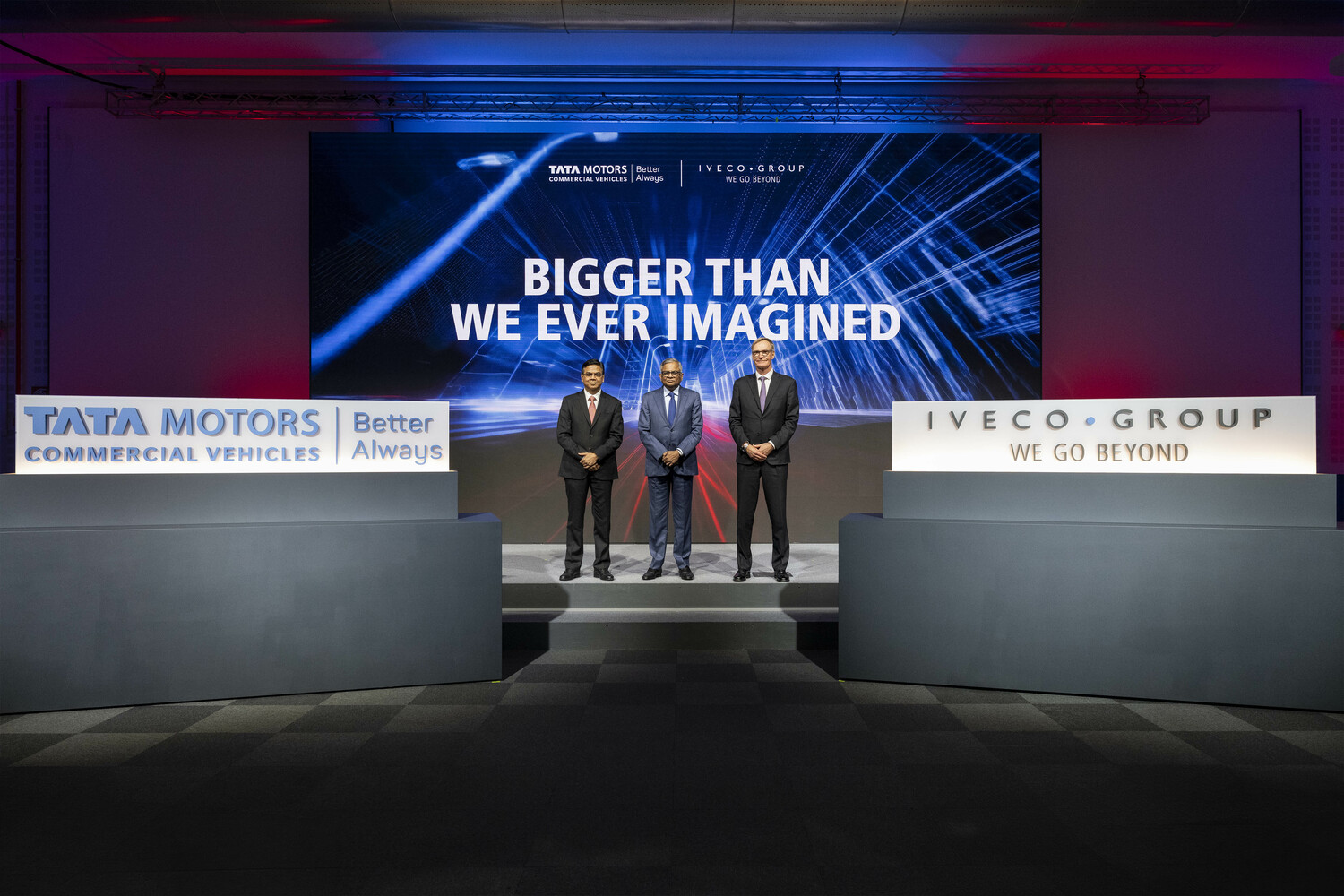
TruckStop was in Turin, Italy, on November 3, 2026, to attend the official presentation of the merger between Tata Motors and Iveco Group. This strategic alliance creates the world's fourth-largest manufacturer of commercial vehicles over six tonnes. Beyond the impressive figures, the deal could provide IVECO with the resources it needs to remain competitive in a European market where industrial consolidation has fundamentally changed the rules of the game. A new chapter is beginning for the Italian manufacturer. The question is how that story will unfold.
A New Chapter Begins in Turin
It was in its historic home of Turin that IVECO officially presented its new identity. Now part of India's Tata Motors group, the Italian manufacturer is entering a new era in its industrial and commercial development.
To mark the occasion, executives from both companies gathered international media representatives. TruckStop was there to discover the ambitions behind the new organisation and, above all, to understand what this alliance could mean for IVECO's future.
N. Chandrasekaran, Chairman of Tata Sons, Tata Motors and Iveco Group, Girish Wagh, Managing Director of Tata Motors, and Olof Persson, CEO of Iveco Group, outlined their shared vision.
Their message was clear: this is not simply about combining two manufacturers to achieve cost savings. The ambition is to build a global player capable of competing with the biggest names in road transport. An ambition that becomes particularly relevant when examining the evolution of the European heavy-duty truck market.
Could IVECO Have Continued on Its Own?
This is probably the fundamental question behind the deal.
For several years, the European commercial vehicle market has increasingly been dominated by powerful industrial groups. TRATON brings together brands including Scania, MAN and International. Daimler Truck commands enormous industrial and financial resources, while Volvo Group benefits from a portfolio that includes Volvo Trucks, Renault Trucks and Mack Trucks in the United States.
Against these giants, IVECO has occupied a distinctive position: a historic European manufacturer with a comprehensive product range, considerable technological expertise and a strong identity in Southern Europe, but operating on a smaller scale than its main competitors.
Developing new engines, investing in electrification, exploring hydrogen technologies, integrating increasingly sophisticated software and complying with demanding environmental regulations all require enormous financial resources. In this investment race, size has become a decisive advantage.
Could IVECO have continued independently? Probably, at least for some time. But with what investment capacity and what long-term prospects?
This is where the partnership with Tata Motors makes strategic sense. By becoming part of a global industrial group, IVECO may have found the partner it needs to remain competitive rather than gradually falling behind its larger rivals.
A New Giant with Impressive Figures
The figures presented in Turin illustrate the scale of the new alliance.
€21 billion in combined revenue.
Approximately 590,000 vehicles sold annually.
More than 73,000 employees across six continents.
27 manufacturing facilities and 25 research and development centres.
Over 9,300 sales and service locations worldwide.
Operations in more than 130 countries.
Together, Tata Motors and Iveco Group now claim fourth place worldwide by sales volume in the commercial vehicle segment above six tonnes.
However, beyond their combined size, the real attraction of this deal lies in the complementary strengths of the two companies.
Tata Motors has a dominant position in India and a significant presence in emerging markets across Asia, Africa and the Middle East. IVECO contributes its European experience, its established position in Latin America, its heavy-duty truck expertise and its powertrain capabilities through FPT.
Rather than competing directly in their principal markets, these two industrial groups have the potential to reinforce each other's strengths.
Tata Takes Control, but IVECO Retains Its Identity
One of the major questions surrounding the official presentation was naturally what would remain of IVECO's Italian identity under Indian ownership.
On this issue, the executives were keen to offer reassurance.
Iveco Group's headquarters will remain in Turin. Its brands, employees and manufacturing operations will retain their individual identities. Tata Motors also intends to support the strategies and investment programmes already underway. During discussions with journalists, Olof Persson confirmed that planned investments in Italian facilities for the 2026–2028 model years would continue.
FPT facilities, particularly those in Turin and Brescia, as well as Bourbon-Lancy in France, remain central to this strategy. Executives also emphasised their commitment to retaining European expertise and developing new activities in engineering, software and automation. These commitments, however, will ultimately need to be demonstrated through concrete actions.
Although preserving IVECO's identity is currently a clear priority, the industrial strategy adopted over the coming years will determine how much genuine independence the Italian manufacturer retains.
FPT: One of the Alliance's Greatest Assets
Among the many potential synergies discussed during the conference, one name repeatedly stood out: FPT. IVECO's powertrain specialist represents a significant technological asset for the newly combined group. Its expertise extends from conventional diesel engines to natural gas, electric powertrains and alternative propulsion technologies.
For Tata Motors, access to this knowledge opens important opportunities, particularly for certain vehicles within its existing portfolio and for industrial applications outside Europe. However, Girish Wagh provided an interesting clarification during the press conference: Tata Motors intends to maintain its longstanding partnership with Cummins for heavy-duty trucks sold in the Indian market.
FPT engines will therefore not automatically replace existing powertrain solutions. Instead, the objective is to exploit technological complementarities wherever they offer genuine advantages. This pragmatic approach could allow both companies to accelerate development while controlling costs.
Cooperation could also extend to batteries, components, vehicle platforms and digital technologies — areas in which pooling resources is becoming increasingly important for remaining competitive.
New Commercial Opportunities Around the World
Another major advantage of the alliance is the opportunity to expand into new markets. With more than 9,300 sales and service locations, the combined group benefits from an exceptionally extensive global network.
Tata vehicles could potentially take advantage of IVECO's established presence in selected regions, particularly Latin America. Conversely, certain IVECO products and technologies could find new customers in markets where Tata has traditionally enjoyed a strong position. During the conference, executives specifically mentioned the possibility of introducing selected IVECO products into India through local assembly operations.
The strategy is therefore not necessarily to sell identical vehicles in every market, but rather to capitalise on each manufacturer's strengths to create new opportunities. Over time, this approach could generate additional production volumes and improve the profitability of industrial investments.
What Could Change for European Transport Operators?
This is naturally the question of greatest interest to TruckStop readers. In the short term, executives are promising continuity.
Existing contracts, warranties, dealer relationships and after-sales services will remain unchanged. IVECO customers should therefore not experience any immediate disruption to their dealings with the manufacturer. Over the longer term, the outlook could become considerably more interesting.
With the financial and industrial backing of Tata Motors, IVECO could gain additional resources to renew its vehicle ranges, accelerate the development of new powertrain technologies and strengthen its competitiveness. In the fiercely competitive heavy-duty truck segment, this increased scale could become an important advantage, particularly by shortening the development time of new products.
However, belonging to a major industrial group does not automatically guarantee commercial success. Transport operators will continue to evaluate vehicles against very practical criteria: reliability, fuel consumption, total cost of ownership, after-sales service quality and residual value.
These are areas in which IVECO is currently facing certain difficulties, particularly in France. It is through measurable improvements in these areas that the new group will ultimately have to demonstrate the real benefits of its alliance.
A Strategic Deal, but Many Questions Remain
In Turin, the presentations were naturally focused on the future, with a clear ambition to build a strong, innovative and sustainable industrial group. Nevertheless, several important questions remain unanswered. What role will IVECO actually play in the strategic decisions of the combined organisation? How will investments be allocated between Europe and India?
Will industrial synergies genuinely reduce costs without compromising the distinctive characteristics of the individual brands? And perhaps most importantly, will Tata Motors give IVECO the freedom and resources to pursue a product strategy tailored to the specific requirements of the European market? These are far from minor considerations. The history of the automotive and commercial vehicle industries has demonstrated that mergers and acquisitions can create remarkable opportunities, but can also lead to difficult industrial decisions.
The executives repeatedly emphasised that their strategy is focused on growth rather than rationalisation. That is an encouraging direction, but one that will need to be confirmed over time.
A Decisive New Chapter for IVECO
Leaving the official presentation in Turin, one impression stands out: IVECO has probably just taken one of the most significant steps in its recent history. In a European market increasingly dominated by a handful of major industrial groups, remaining independent would have presented an ever-greater challenge. The Italian manufacturer possesses expertise, heritage, established products and genuine credibility in the transport industry.
Yet these qualities alone are no longer always sufficient when manufacturers must simultaneously invest in multiple technologies, develop new vehicles and compete on a global scale. With Tata Motors, IVECO is entering a completely different league. The new slogan, "Bigger than we ever imagined," leaves little room for ambiguity. The Indian group brings financial strength, international reach and the capacity to pursue opportunities in new markets.
IVECO contributes its experience, technology, brands and European engineering expertise. On paper, the combination appears particularly promising. The challenge now is to turn these complementary strengths into industrial and commercial success — and that challenge remains substantial. Tata Motors may just have given IVECO the resources it needs to secure its future. What remains to be seen is which direction this new global giant will take and, above all, what role the Italian manufacturer will play on the road ahead.
Text: Fabien Calvet