
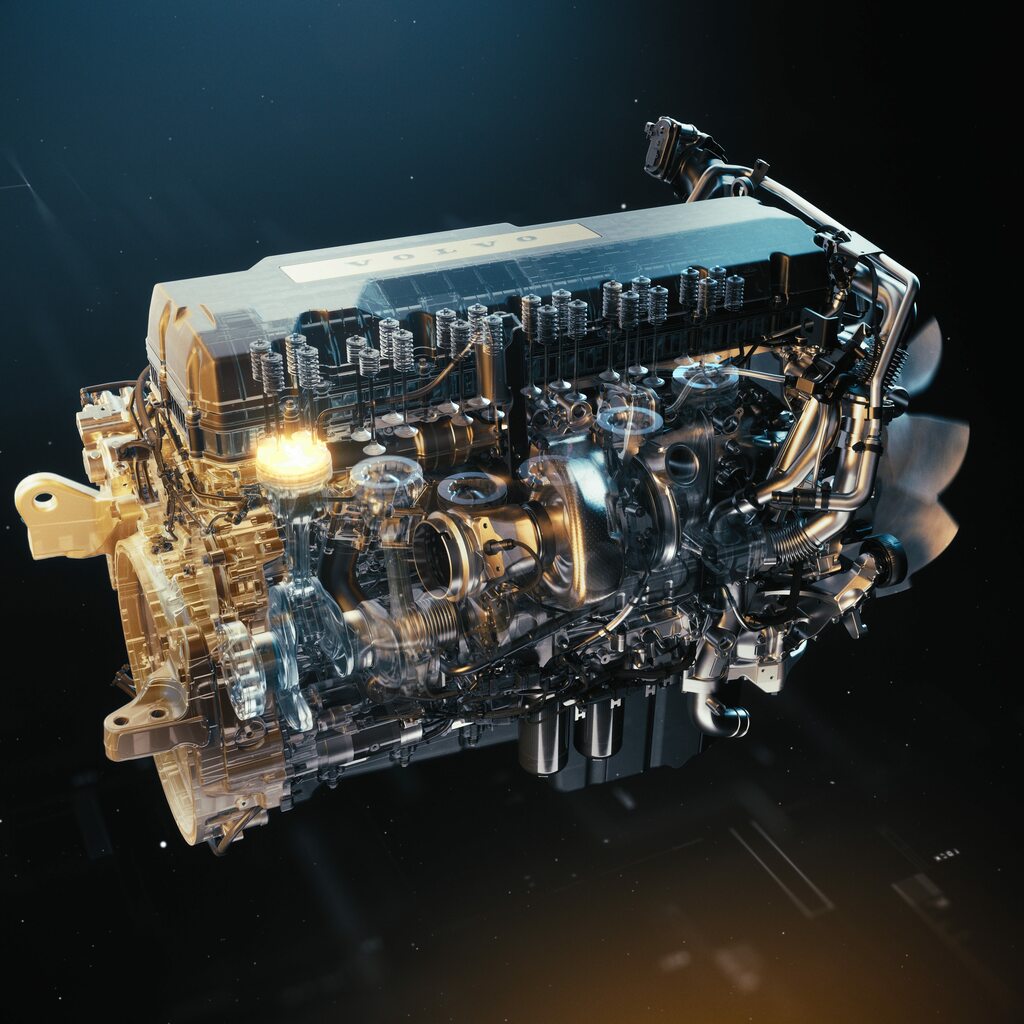
The North American trucking industry is approaching what may be its most significant technological shift since the introduction of SCR systems and diesel exhaust fluid. Beginning in 2027, the U.S. Environmental Protection Agency will enforce dramatically tighter emissions standards, forcing manufacturers to rethink the future of the diesel engine. While much of the industry conversation has centered on electrification, hydrogen and alternative propulsion systems, Volvo is taking a different route. The Swedish manufacturer is making a clear argument that the diesel engine is far from finished. With its newly introduced D13 engine, Volvo Trucks North America is bringing to market a powertrain designed not only to comply with the upcoming EPA 2027 regulations, but also to deliver greater performance, improved fuel economy and lower NOx emissions than any previous engine the company has produced. That is what makes this launch especially important. At a time when fleets are focused on operating costs, infrastructure concerns and long-term reliability, Volvo is offering something the trucking industry values above all else: practical solutions that work in the real world without unnecessary complexity.
Diesel is not disappearing. It is evolving.
Volvo says the new engine reduces nitrogen oxide emissions by more than 80 percent compared with current standards. That is not a minor calibration update. It represents a substantial leap in emissions technology. The new D13 meets the EPA’s stringent 35-milligram NOx standard while remaining compliant in all 50 states. For American fleets, that flexibility matters. Trucks operating in long-haul freight, regional distribution or vocational applications can move across the country without requiring market-specific modifications or additional emissions packages. Perhaps more important is how Volvo achieved those numbers. Rather than introducing a completely new and unproven emissions system, the company chose to build on aftertreatment technology that has already spent more than a decade in commercial service. For fleet operators, that approach may be just as significant as the emissions reductions themselves. The trucking industry remembers the growing pains that accompanied earlier emissions transitions. Reliability issues, downtime and service complications created costly disruptions for carriers across North America. Volvo’s strategy appears designed to avoid repeating that history. In many ways, this new engine is less about revolution and more about refinement. And that may ultimately prove to be its greatest strength.
More power despite stricter regulations
Historically, tighter emissions standards have often come with trade-offs: reduced efficiency, added complexity and compromised performance. Volvo appears determined to challenge that pattern. The new D13 delivers up to 540 horsepower and 1,950 lb-ft of torque. Engine braking performance has also been significantly improved, reaching as much as 630 braking horsepower. For operators hauling heavy loads through mountain corridors and steep grades, particularly in the western United States, that added braking capability is more than a specification sheet headline. Stronger engine braking improves vehicle control, reduces wear on service brakes and enhances overall drivability. Fuel economy remains a central focus as well. Volvo says the new platform is engineered to improve efficiency in both regional-haul and vocational applications while maintaining strong long-distance highway performance. In a freight market where fuel costs continue to shape profitability, even small efficiency gains can have an outsized financial impact.
Volvo is rethinking the entire powertrain ecosystem
Reading between the lines, it becomes clear that Volvo sees this launch as more than simply introducing a new engine. The company has developed the D13 in parallel with its production operations, dealer network, parts distribution and service infrastructure. That may sound procedural, but for fleet customers it is critical. The industry has learned that successful emissions transitions depend as much on support systems as they do on engine hardware. A technologically advanced powertrain means little if parts availability, technician training and service readiness are not in place from day one. Volvo executives appear keenly aware of that reality. Peter Voorhoeve, president of Volvo Trucks North America, described the D13 as the most powerful and fuel-efficient engine Volvo has ever produced. It is a bold statement, but one the company seems prepared to support with a coordinated rollout strategy.
Mack reinforces the Volvo Group strategy
The broader direction of the Volvo Group becomes even clearer when looking at Mack Trucks, which also introduced its EPA 2027-compliant MP13 engine during the ACT Expo in Las Vegas. The similarities are difficult to ignore. Mack’s new MP13 produces up to 540 horsepower and 1,950 lb-ft of torque while also delivering as much as 630 braking horsepower. According to Mack, the engine improves fuel efficiency by up to three percent compared with the previous MP13 generation. The company also emphasized an optimized torque curve that delivers peak torque at just 900 rpm, underscoring the industry’s continued focus on downspeeding strategies aimed at reducing fuel consumption without sacrificing drivability. Mack further highlighted faster communication between the engine and its mDRIVE automated manual transmission, allowing for quicker and smoother gear changes under load. Taken together, the message from Volvo and Mack is remarkably consistent. The future of the diesel engine is not about abandoning the platform. It is about making it cleaner, smarter and more efficient while preserving the durability and practicality fleets still depend on every day.
Renewable fuels are becoming part of the equation
Another area where both Volvo and Mack are clearly aligned is fuel flexibility. The new Volvo D13 is compatible with renewable diesel (R100) as well as biodiesel blends up to B20. Mack has expanded its MP13 capability in the same direction, increasing biodiesel compatibility from B10 to B20. That may sound like a technical detail, but strategically it matters. Many fleets are searching for ways to reduce carbon emissions immediately without making the enormous capital leap to battery-electric trucks. Renewable diesel is increasingly viewed as one of the most practical short-term solutions, particularly in North America where supply infrastructure continues to expand. Volvo’s positioning here is notably pragmatic. The company is not forcing customers into a single technological pathway. Instead, it is offering an engine capable of working within existing operating models while still supporting lower-carbon fuel alternatives.
The real message behind the new D13
Look closely at Volvo’s presentation and one thing becomes clear very quickly: this is not simply about launching a new engine. Volvo is selling confidence. Confidence for fleets that need predictable operating costs beyond 2027. Confidence for owners who cannot afford downtime tied to unproven technology. And confidence for trucking companies whose businesses still rely on diesel-powered equipment moving freight across North America every single day. While much of the transportation sector continues to focus on the distant future, Volvo is addressing the immediate realities of the industry as it exists today. And today, global freight still runs overwhelmingly on diesel. The new D13 ultimately sends a clear signal: the modern heavy-duty diesel engine is not nearing extinction. It is becoming cleaner, more efficient and more advanced than ever before.