
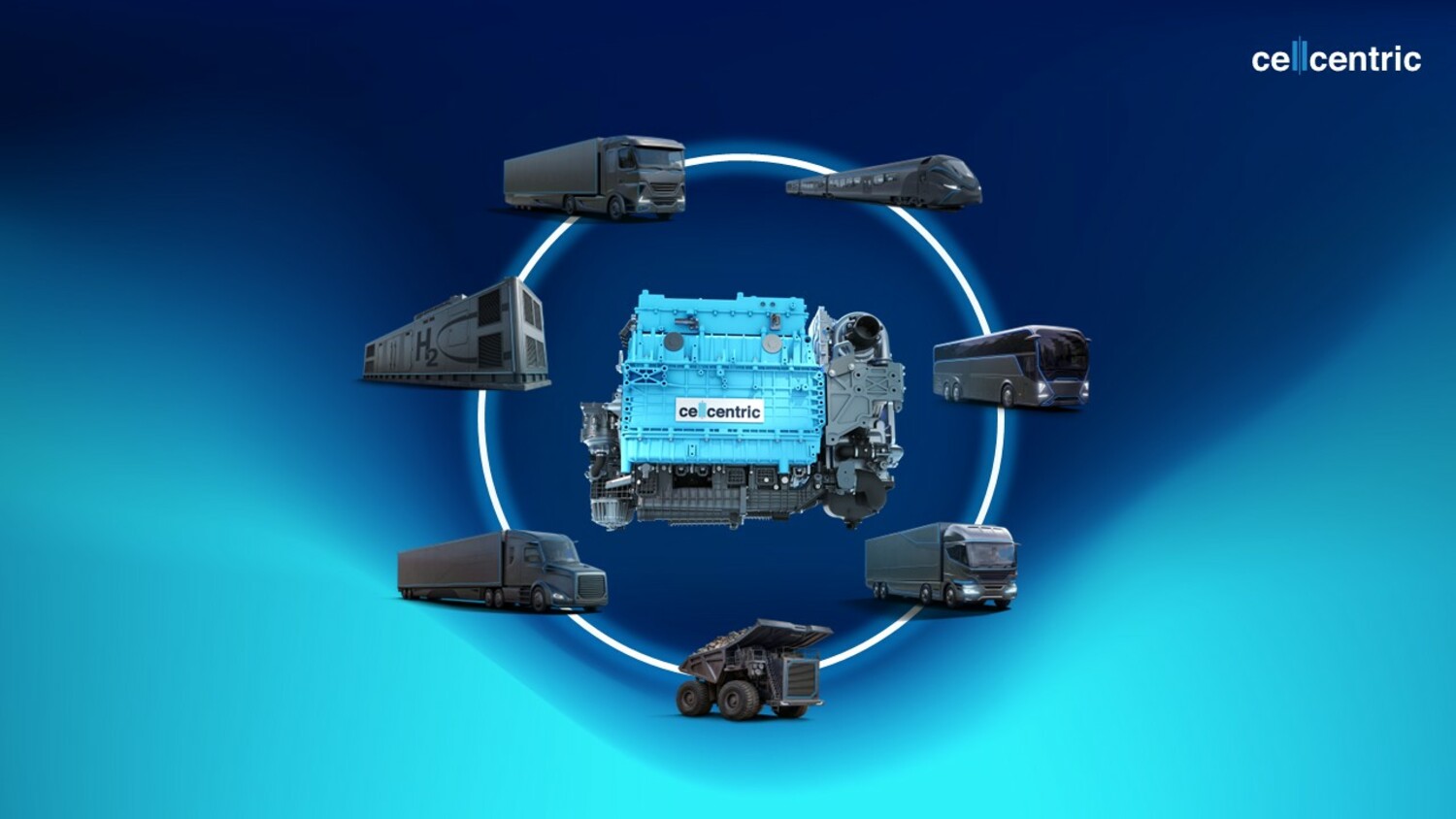
cellcentric, the specialist in fuel cell systems for heavy-duty applications, has officially launched its next-generation fuel cell system under the series designation BZA375. Previously known under the project name “NextGen” and unveiled during a dedicated cellcentric event at the Hannover Messe 2026 (April 20–24, 2026), the system is now available for testing, validation and further industrial scaling across a broad range of heavy-duty applications.
As a Tier 1 supplier with a clear focus on heavy-duty trucks and similarly demanding use cases, cellcentric is taking aim at one of the defining challenges of transport decarbonization: making zero-emission propulsion technology truly competitive, durable and versatile enough for some of the world’s toughest applications.
Designed to Challenge Diesel in the Toughest Applications
BZA375 demonstrates how fuel cell systems can be optimized for the requirements of heavy-duty trucks and other applications with similarly high demands. Developed in less than three years, the system is the result of innovative engineering solutions, continuous refinement and a deep understanding of customer needs. Designed in line with OEM performance and quality standards, BZA375 is engineered to compete directly with modern diesel engines in the most demanding operating environments.
At the core of BZA375’s development lies a relentless focus on reducing Total Cost of Ownership (TCO) — the decisive factor in purchasing decisions for heavy-duty customers. To achieve this, BZA375 pushes the boundaries of fuel cell technology.
“BZA375 has been specifically tailored to the requirements of long-haul trucking and is equally suited to other applications with comparable demands. At cellcentric, we have deliberately positioned ourselves as an independent Tier 1 supplier and remain open to partnerships with all OEMs committed to decarbonizing their product portfolios,” said Nicholas Loughlan, CTO of cellcentric.
“Two key technologies will define the road toward transport decarbonization: battery-electric and hydrogen-based drivetrains. We have already taken major steps forward, and cellcentric’s new fuel cell system marks the next major milestone. Building on the success of its predecessor, it delivers a new level of efficiency and performance,” said Karin Rådström, President and CEO of Daimler Truck
“With the launch of BZA375, cellcentric and its partners have paved the way for zero-emission long-haul transport in the heavy-duty segment. This represents a milestone for logistics companies and society as a whole, bringing the industry another step closer to decarbonization,” said Martin Lundstedt, President and CEO of Volvo Group
A Single-System Fuel Cell with Lower Costs and Higher Efficiency
Key performance figures of the BZA375 at a glance:
- Up to 375 kW continuous net output — more than 500 horsepower — from a single-system package
- 20 percent lower fuel consumption compared to cellcentric’s previous BZA150 fuel cell system, enabling a fully loaded 40-ton truck to operate on less than 6 kilograms of hydrogen per 100 kilometers under real-world driving conditions
- 40 percent less waste heat at 300 kW net output compared to BZA150, allowing for significantly more compact and cost-efficient cooling systems
- 40 percent higher power density than BZA150, simplifying integration into existing vehicle architectures and designed to fit installation spaces originally developed for conventional 13-liter diesel engines
- 40 percent lower complexity compared to BZA150, thanks to a substantial reduction in components and interfaces
- Weight below 500 kilograms, helping maintain payload capacities at levels customers expect from proven diesel technology
The BZA375 single-system package enables the transition away from the “twin-system” approach previously used for the BZA150 in heavy-duty truck applications. The new design reduces complexity, eases integration into existing diesel-oriented vehicle platforms and enables a more compact and cost-effective solution for cellcentric’s OEM customers.
All of these advancements have been achieved while maintaining the durability standards that already distinguished the BZA150: a service life of 25,000 operating hours. In a heavy-duty truck, this corresponds to roughly ten years of operation — on par with today’s modern diesel engines.
Prototype production of the BZA375 has already begun. Initial prototypes have been undergoing rigorous performance and durability testing for several months and are now available to cellcentric customers for their own testing and validation programs. Even before series production begins, customers will receive larger volumes of mature prototype systems for testing, validation and initial fleet applications. Serial production is being prepared for the end of the decade.
From Long-Haul Trucking to Mining and Rail: Hydrogen Expands Its Reach
With the introduction of BZA375, cellcentric is positioning its fuel cell system as far more than a solution for long-haul road transport. While the system was primarily designed and optimized for heavy-duty long-distance trucks, it is equally suited for a wide range of other demanding applications with comparable requirements, including coaches, stationary power generation, rail transport and mining.
The competitive specifications of BZA375 allow cellcentric to further pursue its one-product strategy, utilizing a single system across this broad spectrum of applications. The result is significant scaling potential and substantial opportunities for further cost reductions in fuel cell technology.
With BZA375, cellcentric is making the transition from promise to industrial reality. Built on the company’s proven fuel cell expertise, the powerful single-system solution is ready for integration into validation and industrialization programs — not only in the long-haul trucks it was designed for, but anywhere heavy-duty work demands zero-emission performance at scale.
From highways to mines, from rail networks to power grids: BZA375 starts now.